
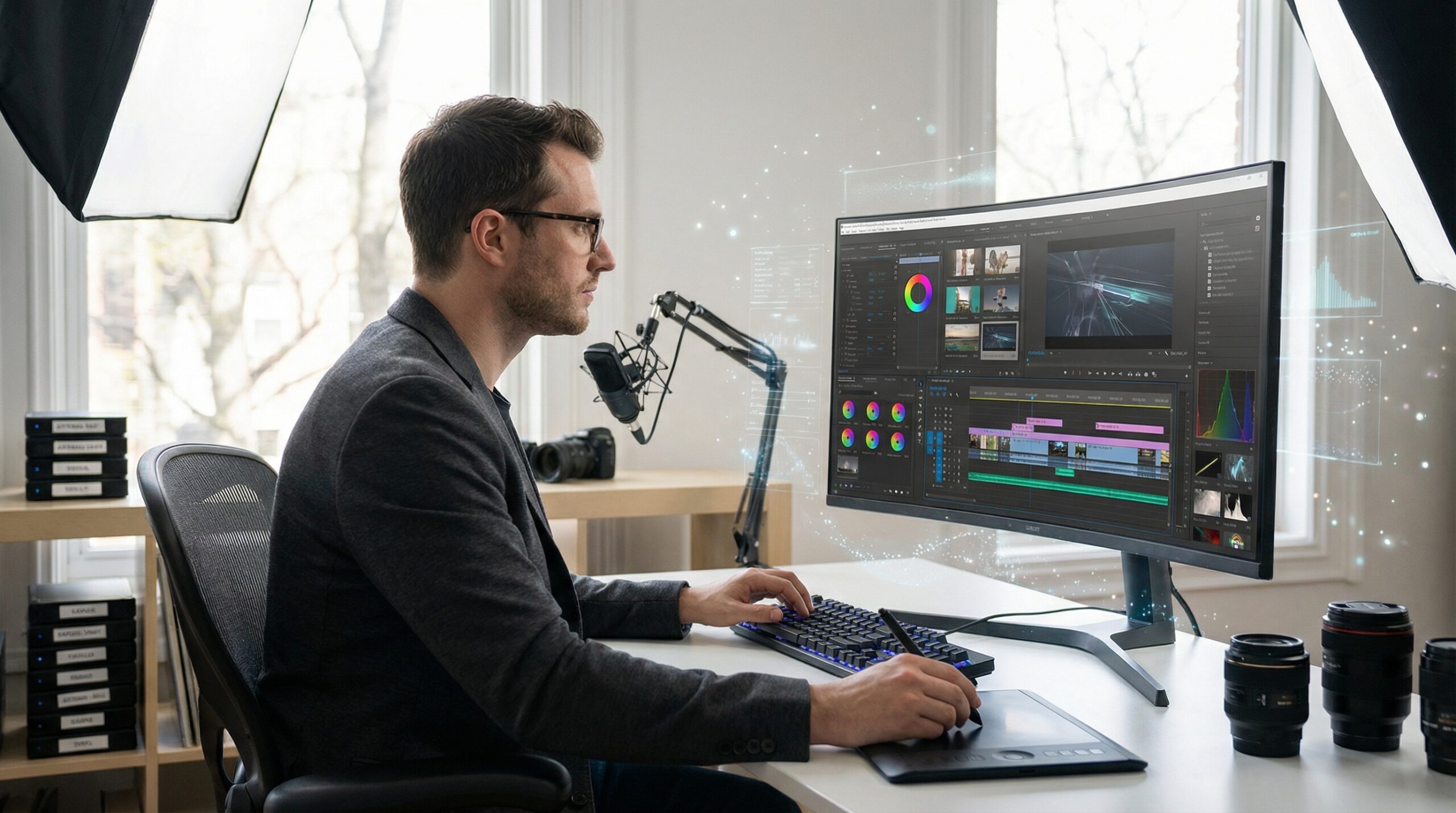
By 2026, short-form vertical video will account for 92% of all mobile data traffic. Despite this volume, 60% of creators lose their audience in the first 3 seconds. Are your video editing motion graphics working as a functional UX tool or merely serving as decorative clutter? In an era where 85% of professionals use generative AI daily, the gap between commodity content and authoritative storytelling has never been wider.
Here is how to navigate the shift from manual editing to intelligent curation.
Key Takeaways
- Vertical-First is Mandatory: 92% of mobile data traffic is now driven by short-form vertical video.
- The 60% Efficiency Rule: AI-driven workflows reduce production time by 60%, shifting the editor's role to creative director.
- Spatial Video Growth: Demand for 3D motion graphics has spiked 150% due to mixed-reality headset adoption.
- Functional Typography: 80% of viewers watch on mute, making kinetic typography a core UX requirement.
- Atomic Workflows: One long-form recording must be deconstructed into 50+ platform-specific assets to remain competitive.
- Human Authenticity: Trust and "Human-Made" certifications are the new currency in an AI-saturated market.
Video Editing Motion Graphics: The 2026 Landscape
The digital landscape has undergone a seismic shift. As a Creative Director with over a decade of experience, I've watched the industry evolve from static graphics to the complex, AI-integrated ecosystems we navigate today. In 2026, video editing motion graphics are no longer about making things move.
They are the primary interface through which brands communicate authority and value. The dominance of vertical-first content is total. Recent data indicates that vertical video yields a 35% higher retention rate than traditional horizontal formats.
This isn't a trend; it's a fundamental change in human consumption habits. Mobile-first design now requires centering all critical motion and information within the middle 60% of the vertical frame. This avoids UI interference from platform overlays like "Like" buttons or captions.
The result? We've moved from the era of the pixel-pusher to the era of the Creative Curator. The modern editor doesn't spend four hours on a rough cut. Instead, they use multi-agent AI systems to handle the mechanical labor.
This allows them to focus on high-level narrative and brand strategy. This shift is essential for SaaS companies and solopreneurs who need to scale without exploding their headcount.
Pro Tip: When designing for vertical platforms, treat the top and bottom 15% of your frame as "dead zones." Keep your kinetic typography and call-to-actions in the center safety zone to ensure they aren't covered by platform UI elements.
Generative AI and the 60% Efficiency Rule
Efficiency is the heartbeat of modern production. According to a 2025 industry report, 85% of professional video editors now integrate generative AI tools into their daily workflows. This isn't about replacing the artist.
It's about the 60% Efficiency Rule. By automating the rough cut, subtitling, and initial color grading, we reduce production time by 60%. This allows for more iterations and better creative outcomes.
At Narratives Media, we've pioneered the use of Cortex AI to automate these tedious aspects of the creative process. Imagine a world where your initial assembly is done before you even open your software. AI-driven localization has also changed the game, lowering global distribution costs by 70%.
We can now clone a founder's voice and sync their lip movements to ten different languages with a single click. Dynamic asset generation allows us to maintain Brand DNA across thousands of clips. Instead of manually creating every lower-third or transition, we feed brand guidelines into AI pipelines.
These pipelines generate consistent, high-fidelity motion graphics on the fly. This level of scale was once reserved for global agencies with seven-figure budgets. Now, it's available to any solopreneur with the right tech stack.
Spatial Video: Designing for the Mixed-Reality Era
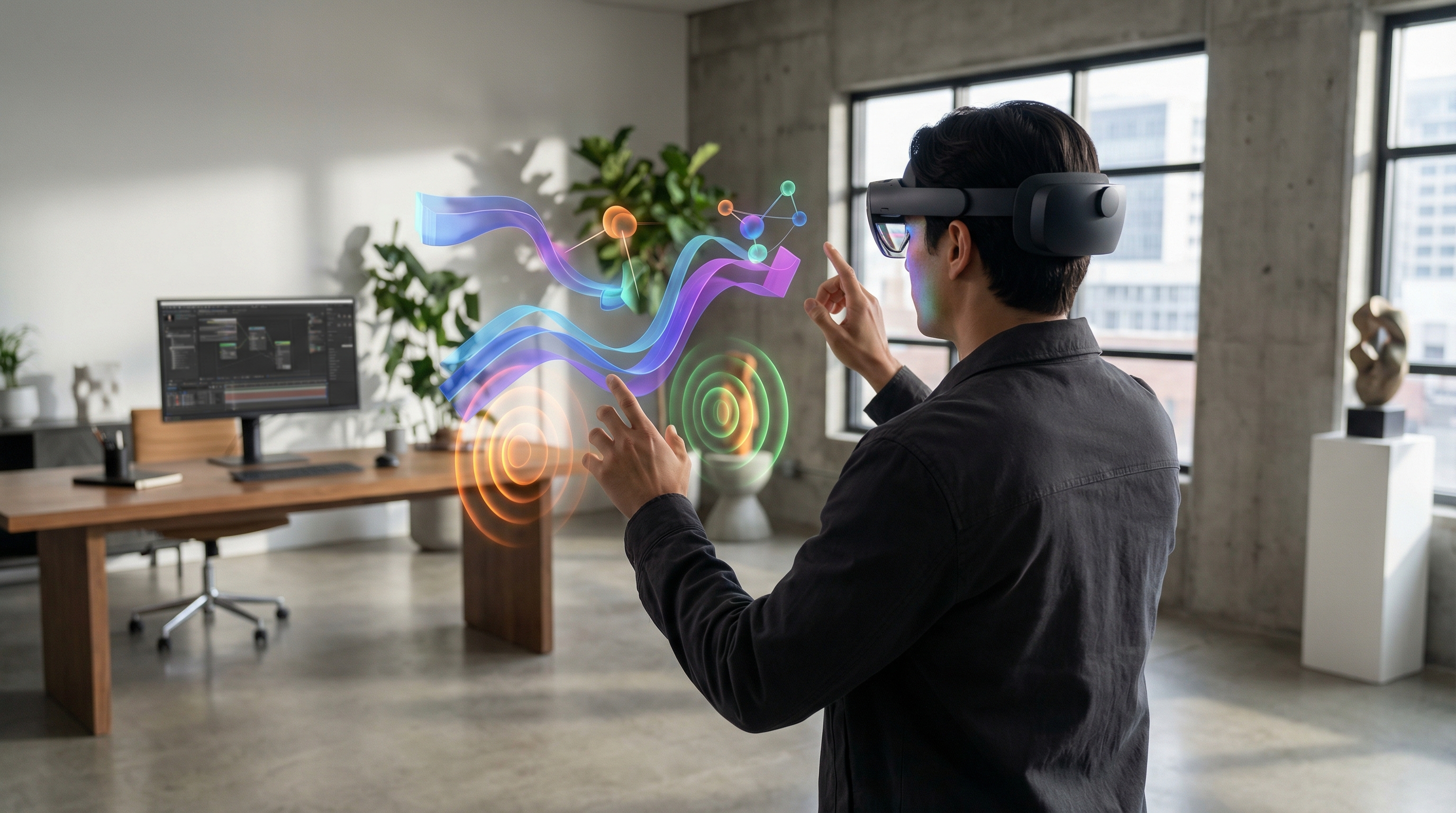
The release of advanced headsets like the Apple Vision Pro and Meta Quest 4 has triggered a 150% increase in demand for spatial video. Traditional 2D video editing motion graphics are being supplanted by depth-based visual hierarchies. Users now expect to step into the content.
Spatial video requires a complete rethink of motion design. We are no longer working on an X and Y axis. The Z-axis (depth) is now our most powerful storytelling tool.
This is particularly relevant for SaaS product demos and luxury real estate showcases. Imagine a user wearing a headset and seeing your software interface floating in their physical room. Motion graphics highlight key features in 3D space around them.
Sound design has also become more critical than ever. In immersive environments, audio accounts for 50% of the perceived quality. Spatial audio—where the sound moves as the user turns their head—is no longer a luxury.
It's a requirement for maintaining immersion. If your motion graphics don't have corresponding spatial audio triggers, the experience feels hollow.
| Feature | Traditional Video | Spatial Video (2026) |
|---|---|---|
| Primary Axis | X and Y (Flat) | X, Y, and Z (Depth) |
| Viewer Perspective | Fixed / Passive | Variable / Immersive |
| Sound Design | Stereo / Mono | Spatial / Object-Based |
| Interaction | Click / Tap | Gesture / Gaze |
| Use Case | Social Media Feeds | MR Headsets / Pro Demos |
Kinetic Typography and the Science of Mute-Viewing
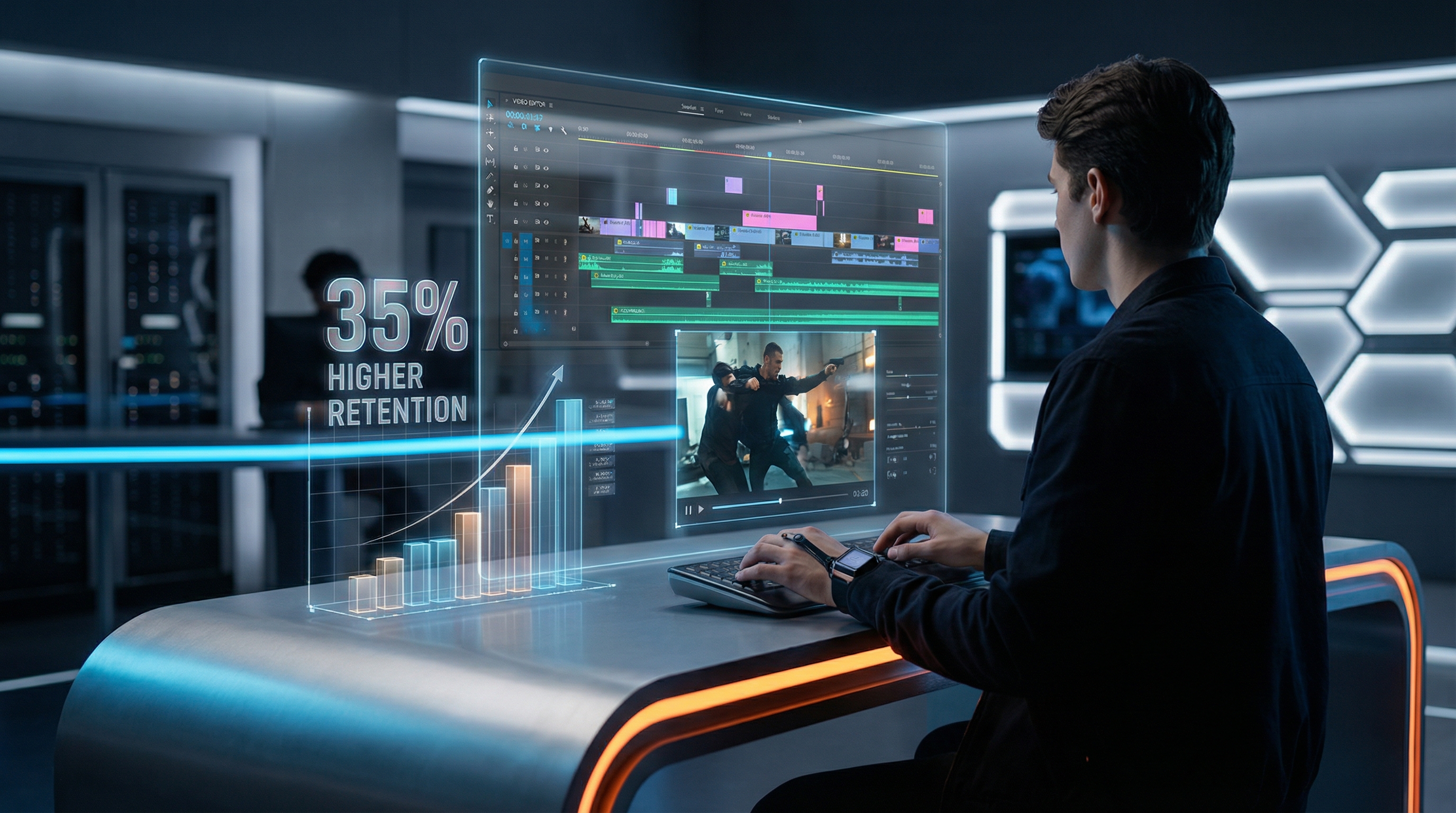
Let's be honest: 80% of your audience is watching your video on mute. Whether they are in a meeting, on a train, or scrolling late at night, your audio is often a secondary concern. This reality has turned kinetic typography into a mandatory functional UX tool.
If your video doesn't read as well as it looks, it's failing. In 2026, typography is used to reduce user friction. For SaaS product walkthroughs, we use micro-animations to guide the eye toward specific UI elements.
This isn't about subtitles; it's about bold, high-contrast, mobile-first design that pops on a small screen. The science of Mute-Viewing dictates that text must be legible within 0.2 seconds of appearing. This means avoiding overly decorative fonts and focusing on weight and contrast.
I've found that using high-contrast yellow or white text with a subtle black drop shadow remains the gold standard for readability across diverse video backgrounds.
"The most effective motion graphics in 2026 aren't the ones that look the flashiest. They are the ones that make the message impossible to miss, even with the volume turned off."
Pro Tip: Use "Pop-on" animations rather than slow fades for your captions. Fast-paced, kinetic text triggers a psychological completion response in viewers, encouraging them to keep watching until the next word appears.
Scaling Video Editing Motion Graphics with Atomic Workflows
The Atomic Workflow is the methodology we use at Narratives Media to help brands stay always-on. The concept is simple: one long-form recording—be it a podcast, an interview, or a keynote—is the Atom. From this single atom, we use AI agents to deconstruct the content into 50+ platform-specific assets.
Tools like JustPod have revolutionized this for multi-camera setups. In the past, editing a multi-cam podcast took hours of manual switching. Now, a single click handles the cuts based on who is speaking.
This leaves the editor to focus solely on the motion graphics and the narrative arc. This is how small teams are outperforming massive agencies in 2026. SaaS marketing managers are now shifting 55% of their budgets toward these automated creation platforms.
The goal is to build a content engine that never stops. By leveraging RankHiker for SEO insights, we can identify trending topics before they peak. This ensures our atomic clips are optimized for both Google and LLM-based search engines like Perplexity.
Real-Time Rendering: The End of the Export Bar
One of the greatest bottlenecks in the history of video editing motion graphics was the export bar. We've all spent hours waiting for a 4K render to finish, only to find a typo and have to start over. In 2026, real-time rendering via game engines like Unreal Engine 5.5 has ended this frustration.
This technology is now used for 40% of high-end commercial productions. The integration of game engine technology into video editing allows for instant feedback loops. You can change the lighting, the camera angle, or the motion of a 3D asset and see the result immediately.
This acceleration of the creative iteration process is invaluable when working with demanding international clients. Furthermore, real-time engines allow us to integrate live data feeds into our motion graphics. Imagine a video ad that updates its pricing or "units remaining" in real-time, based on your current inventory.
This level of dynamic storytelling creates a sense of urgency and relevance that static video simply cannot match.
Interactive Narrative and Shoppable Hotspots
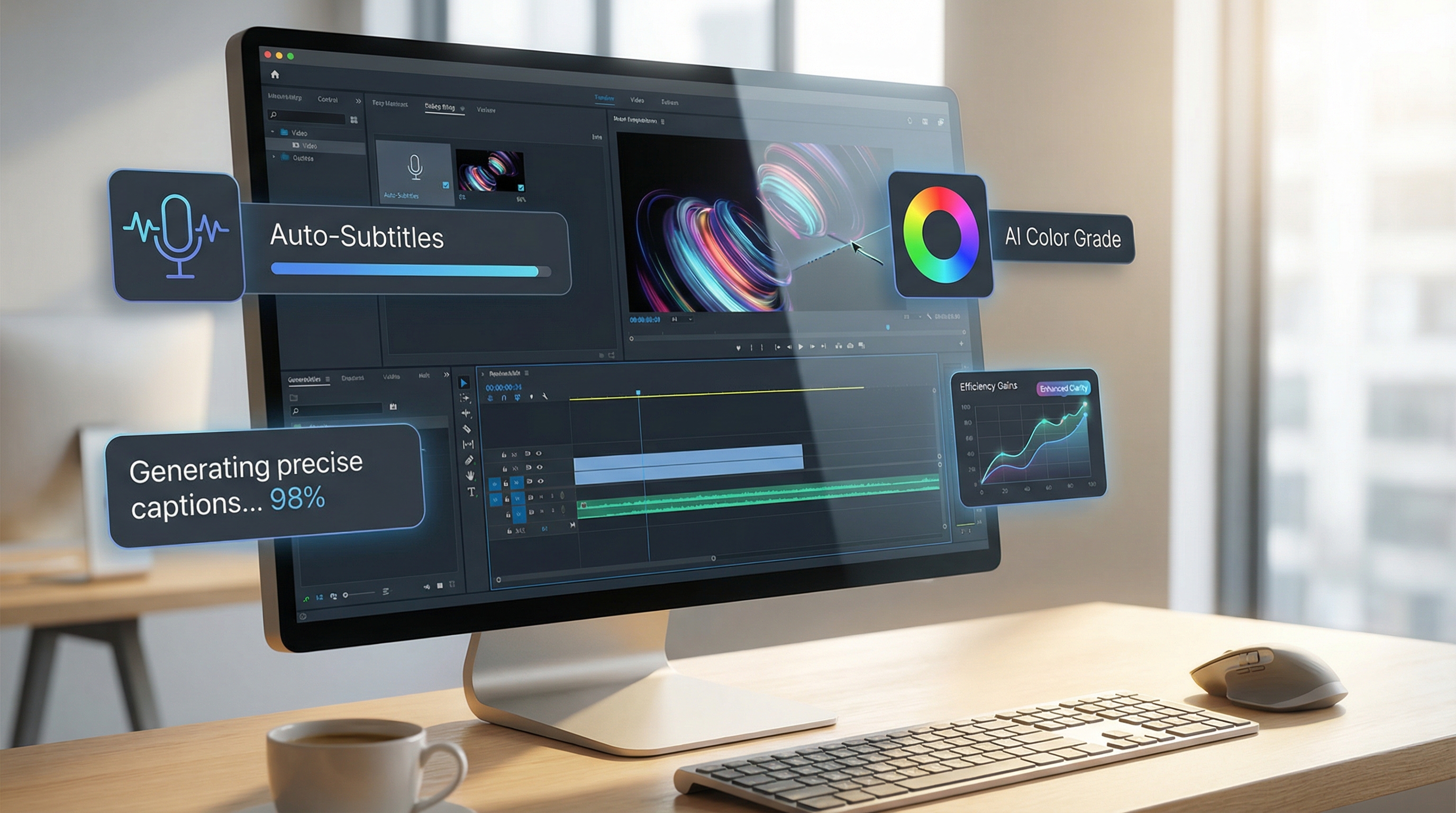
Why settle for a view when you can get a conversion? Interactive video content, featuring branching narratives and shoppable hotspots, yields a 3x higher conversion rate for SaaS companies compared to traditional linear video. In 2026, the video player is no longer a passive window.
It is a storefront. In B2B sales, personalized video messaging has improved meeting booking rates by 22%. We use AI to generate custom video messages for every lead in a funnel.
The motion graphics dynamically change to show the prospect's own website or data. This creates an immediate "aha" moment that a generic cold email could never achieve. Shoppable hotspots allow viewers to click on an item—or a software feature—directly within the video.
This removes the friction between discovery and action. For a solopreneur, this means your video content isn't just building brand awareness. It's actively managing your sales pipeline while you sleep.
Pro Tip: Don't over-complicate your branching narratives. Offer no more than two choices at a time. Too much complexity leads to decision fatigue, causing the viewer to exit the video entirely.
Why Video Editing Motion Graphics Still Need a Human Touch
In a world saturated with AI-generated content, "Human-Made" has become a luxury brand. While we use AI for 90% of the labor, the final 10%—the taste, the pacing, and the emotional resonance—must remain human. I call this the Sovereign Creator model.
It's about using technology to amplify your unique voice, not replace it. Authenticity loops are a powerful way to build trust. I've found that including raw, unpolished, behind-the-scenes segments within high-production videos actually increases engagement.
It proves there is a real person behind the brand. In the age of deepfakes, content provenance and digital watermarking are becoming essential for maintaining authority. Avoid generic AI templates.
Nothing kills brand authority faster than a video that looks exactly like a thousand others. Use AI to build custom tools and workflows that reflect your specific Brand DNA. These human choices are what create lasting community.
Essential 2026 Tech Stack for SaaS and Solopreneurs
To compete in 2026, you need a stack that balances power with automation. Based on my work building and using these tools, here is the roadmap for a high-output creative engine:
- RankHiker: This is your starting point. Use it to identify what people are searching for on LLMs and Google. It ensures your video topics are data-driven.
- Cortex AI: This handles the Atomic heavy lifting. It automates the creation of dozens of social clips from your master recordings.
- JustPod: If you do any podcasting or multi-cam interviews, this Premiere Pro plugin is non-negotiable. It handles the manual switching instantly.
- Adobe Creative Cloud (Premiere & After Effects): Still the industry standard for high-end manual touches and complex motion design.
- Unreal Engine 5.5: For real-time 3D motion graphics and spatial video content that needs to stand out in the mixed-reality market.
Actionable Roadmap for Scaling Video Production
- Step 1: Audit Your Workflow. Identify where you are spending more than 30 minutes on a repetitive task. These are your primary candidates for AI automation.
- Step 2: Adopt a Vertical-First Mindset. Stop cropping horizontal video for social. Design your motion graphics specifically for the 9:16 aspect ratio from the start.
- Step 3: Implement an Atomic Content Strategy. Commit to recording one high-quality Atom per week and turning it into 50 pieces of micro-content.
- Step 4: Focus on Functional Motion. Every animation should have a purpose—to highlight a feature, explain a concept, or drive a click. If it's fluff, delete it.
- Step 5: Build an Authenticity Loop. Integrate raw, human moments into your automated workflows to ensure your brand remains relatable and trustworthy.
FAQ: Navigating the Future of Motion Graphics
How do I use AI to automate video editing without losing my brand's unique voice?
Focus on using AI for Atomic tasks like subtitling, resizing, and initial rough cuts. Keep the final creative direction, color grading, and narrative pacing manual. By controlling the Creative DNA—your specific aesthetic choices—you ensure the AI acts as an assistant, not a replacement.
What are the best Premiere Pro plugins for multi-camera podcast editing in 2026?
JustPod is the leading plugin in 2026 for automated multi-camera switching. It allows creators to sync audio and video across multiple angles instantly. This saves hours of manual cutting and allows solopreneurs to produce agency-level video podcasts solo.
Why is kinetic typography mandatory for social media in 2026?
Since 80% of users watch content on mute, kinetic typography ensures your message is delivered visually. It serves as a functional UX tool to keep viewers engaged without needing audio, significantly increasing retention rates on mobile platforms.
What is the impact of spatial video on traditional digital marketing?
Spatial video adds a layer of depth and immersion that 2D video lacks. This has led to a 150% higher demand in industries like SaaS and real estate, where feeling the interface is key to conversion. It transforms the viewer from an observer into a participant.
How can small business owners scale video production on a limited budget?
The key is adopting a mobile-first atomic workflow. Use tools like Cortex AI to generate multiple assets from a single recording. Combine this with AI SEO tools like RankHiker to ensure your content ranks high with minimal ad spend, maximizing your ROI.
Conclusion: The Era of Intelligent Curation
The future of video editing motion graphics isn't just about faster renders; it's about intelligent curation and spatial immersion. As a solopreneur or SaaS manager, your goal in 2026 is to blend AI efficiency with human authenticity. This is how you build trust in a world where content is abundant but authority is rare.
Whether you are designing for the Apple Vision Pro or optimizing a 15-second Reel, remember that motion must serve a purpose. Don't let your graphics be decorative clutter. Use them to guide, to educate, and to convert.
Ready to scale your content without the headcount? Explore how tools like Cortex AI and RankHiker can automate your workflow today. Visit habibove.com to start building your 2026 creative strategy and stay ahead of the curve.